Options data, research, and analytics
Our team has spent decades in options markets. The question we work on is what the market is actually doing: how activity behaves across names and sessions, where correlations hold and where they break, and which flow is anomalous for a given name rather than merely large.
Answering that at the scale of roughly seventy million contracts a session takes infrastructure most firms do not have. We process the raw OPRA prints, classify them, and reconstruct the orders behind them, because the tape carries no order IDs and no statement of intent. Until that is done, the record is a list of executions rather than a picture of what traded.
We publish what that work turns up. The workspace our own desk trades from is available for licensing, and so is the data layer underneath it. We do not publish recommendations.
- 01 Below bid
- 02 At bid
- 03 Inside bid
- 04 Mid
- 05 Inside ask
- 06 At ask
- 07 Above ask
- 08 Locked
- 09 Crossed
Aggression, not intent. A locked or crossed book is recorded as what it was, not resolved to a side.
Order flow: tagged and reconstructed
The usual reading of the options tape is that a print is an order. A print at the offer is a buy. A wall of prints is one order worked. Two contracts printing together are a spread someone opened.
That sentence treats a report as a reconstruction, and a reconstruction as a fact. A print is a print. An order, a side, and a structure are constructions. Some of those constructions are tagged at the exchange. Most are inferred. They are not the same object.
Read the paper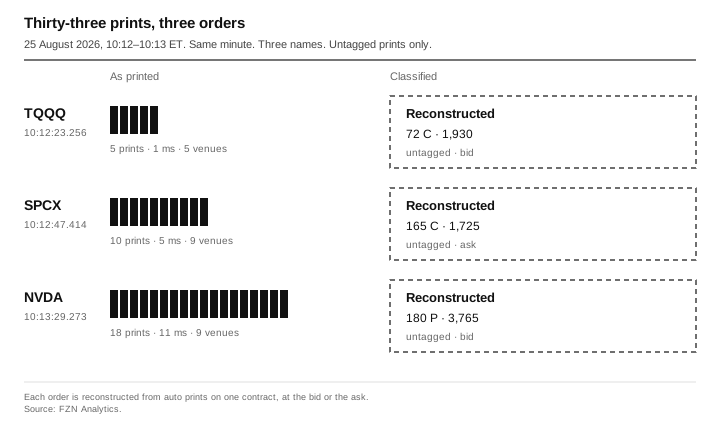
Notes and papers
Written from the desk, on method rather than conclusions. Nothing here is investment advice.- 2026-08-25 Order flow: tagged and reconstructed A single print, or a wall of prints, is treated as an order, a side, a structure. It isn’t, unless you say how you know. Paper
- 2026-08-25 Positioning is not a hedge map Most days the book is being flattened as it is taken. Positioning is a tail object. Open/close is a calm-market tape, and a chart that is right for the wrong reason will keep its believers. Paper
- 2026-08-20 The VIX call book grew for a third session Daily
- 2026-08-19 The book opened 15.16M against 14.26M ADV Daily
- 2026-08-18 SPY puts built for a third session Daily
- 2026-08-17 The VIX call book grew for a third session Daily