See more of the flow, less of the noise
Roughly seventy million options contracts change hands each session. Most tools in this category pick one of them out and tell you a story about it. A single print will not carry that weight; it may be a hedge, one leg of a structure, a roll, or a position that turns out to be wrong.
Meaning sits in aggregate and in structure. We process the raw OPRA tape, classify it, and license the workspace our own desk trades from. Our work is to make the contracts that matter to you findable.
- Reported · condition code
- The exchange assigns it, and we report it as given. A tag on one print does not describe the order it came from; untagged executions often belong to the same order. Codes are where the work starts, not where it finishes, and most tools stop there.
- Read · side
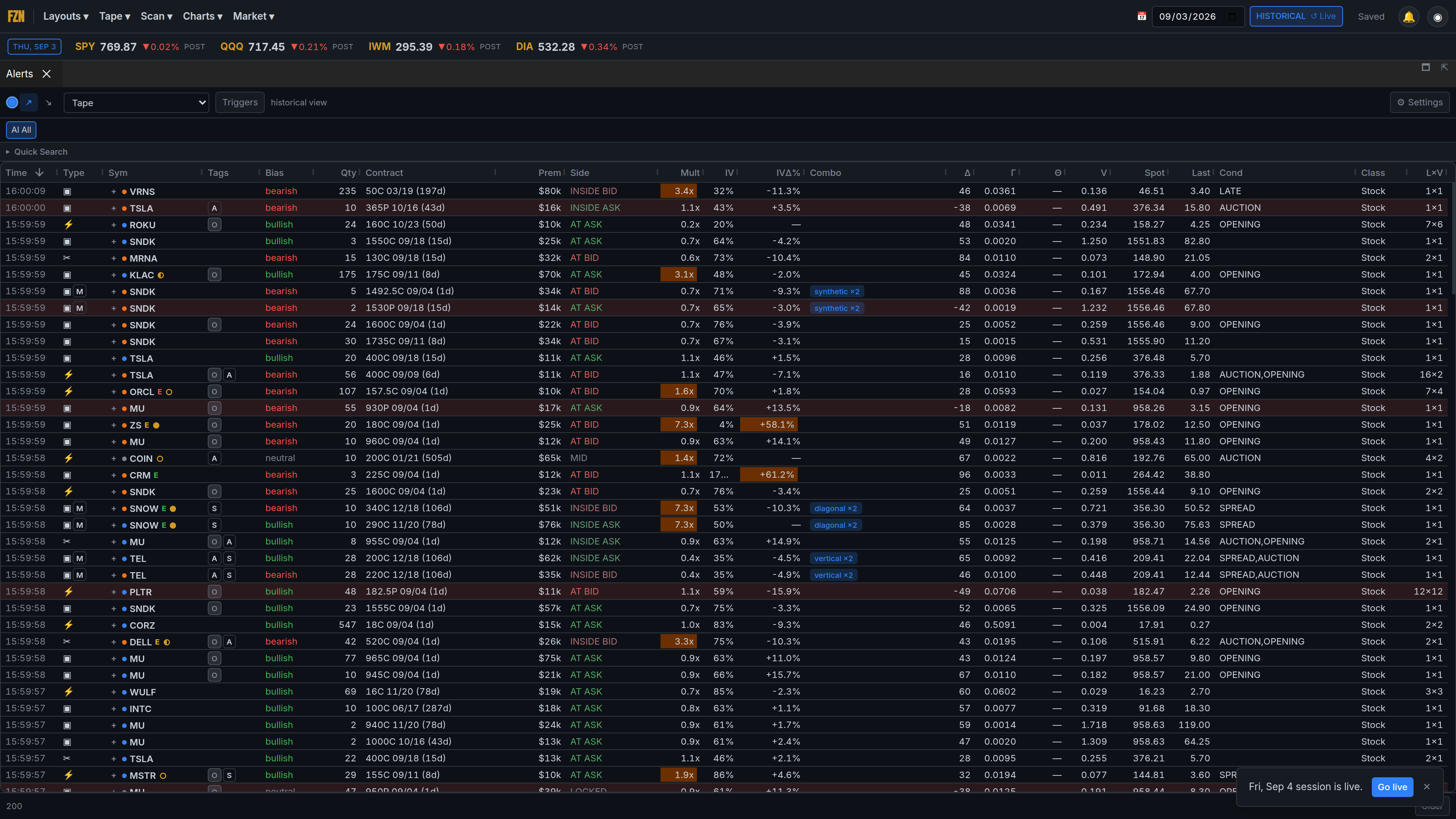
- Measured against the NBBO at the instant of the print, on an eight-rung ladder running from below bid to above ask. Where the book is locked or crossed, the field reads unknown. We would rather report the gap than infer a side from a vendor tag.
- Reconstructed · spread
- The tape carries no order IDs, so structure has to be rebuilt: legs on one root, one venue, one instant, regrouped into the order they likely came from. Rebuilding the order is what surfaces genuinely aggressive flow, rather than whichever prints happened to carry a tag. Named geometry where it is nameable (vertical, calendar, diagonal, straddle, strangle, butterfly, condor, box) and labelled complex where it is not.
We built it because it did not exist
Our team has spent decades in this data. We looked for the platform we wanted and it was not on either side of the market: nothing institutional does this job, no retail feed carries data of this quality, and nothing available at any price puts it in front of a trader the way this does.
So we built it for our own desk first, and we still trade on it every session.
Flow is only readable in aggregate
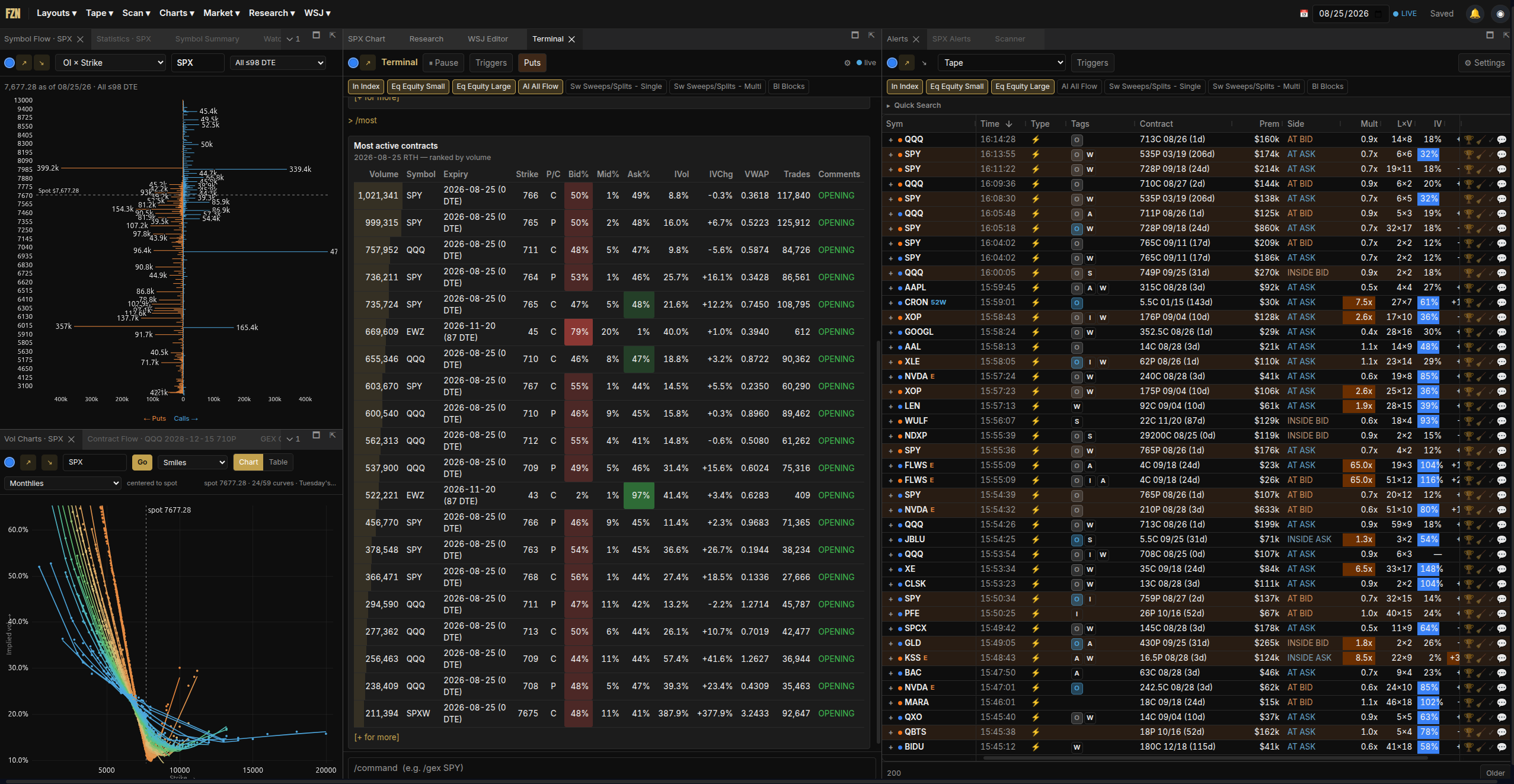
Workspace Pro is a set of linked panes: a live classified tape, ranked boards, aggregate views of the session, gamma-exposure and volatility surfaces, breadth, scanners, watchlists, news and halts, and a terminal pane that opens any of them from the keyboard. The set grows as the desk needs more.
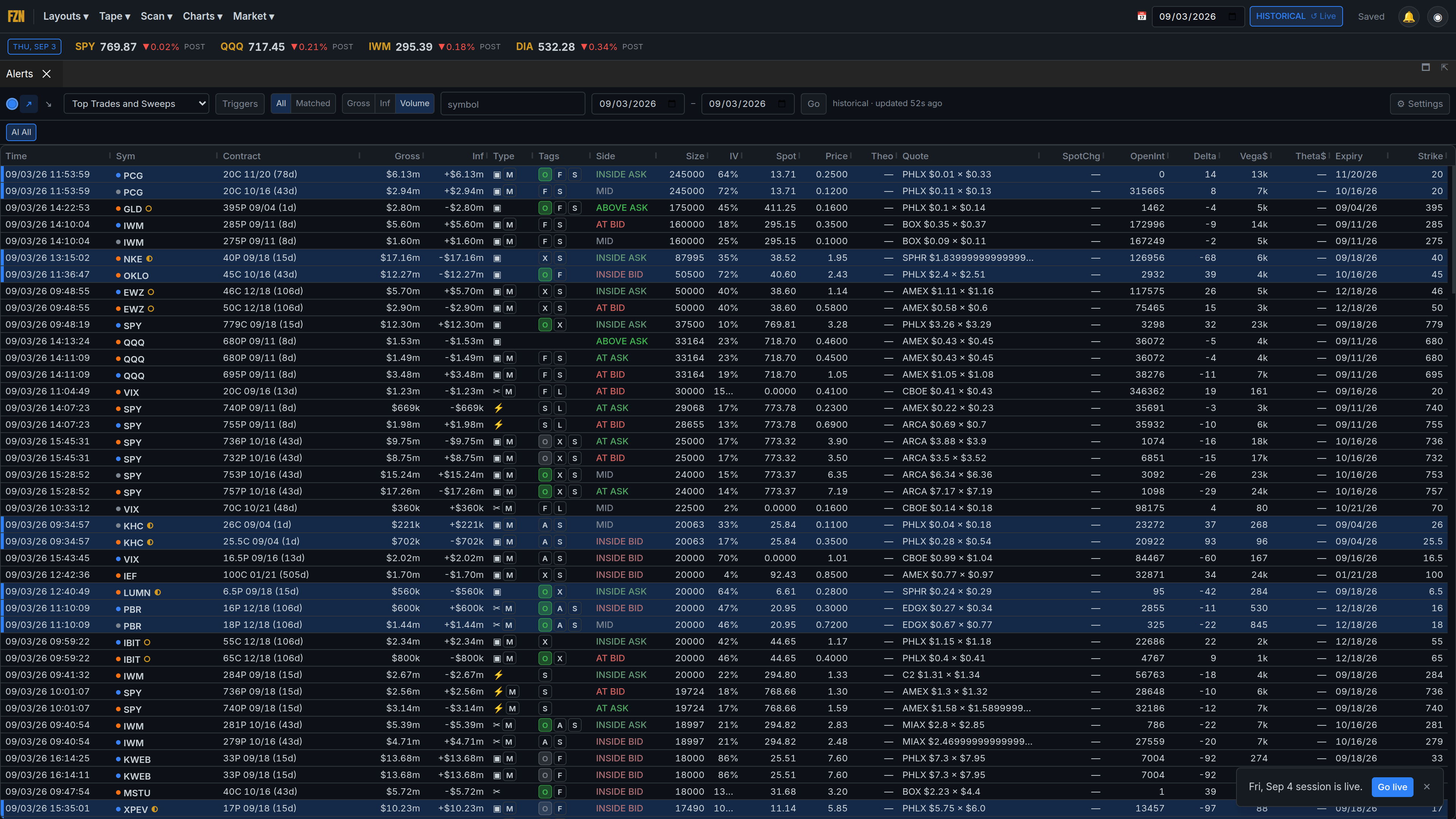
Reconstruction is the foundation. The aggregates are how you use it: rank the session by top sweeps, by unusual volume, by implied-volatility change, by open-interest change, then drill from a ranking straight into the prints underneath it.
FZN Tagged Flow is our own filtered view. It measures a name against how that name normally trades and surfaces the activity that is genuinely out of character for it, rather than whatever happens to be large or happens to carry a tag.
Layouts belong to the trader. Arrange the panes for the part of your session you are in, link them so a selection propagates, and switch layouts as the work changes. The point is fewer minutes assembling context and more of the session spent on decisions.
- TapeClassified prints with condition code, side ladder and reconstructed structure
- AggregatesThe session ranked by top sweeps, unusual volume, implied-volatility change and open interest, drillable to the prints
- Tagged flowOur filtered view: activity that is unusual for that specific name, not merely large
- SurfacesGamma exposure and volatility, read next to market breadth
- LayoutsLinked panes saved per workflow, opened by command from the terminal pane
Who this is for
- Traders who do this for a living.
- Traders who have already learned that most flow products are ninety percent noise.
- Traders who want data that is accurate and actionable, and who will check it before they act on it.
Who it is not for
- Newer traders. The workspace assumes fluency with the tape and with options structure.
- Anyone looking for positions to copy. We publish research, not recommendations.
- Anyone who wants a narrative about another desk's book.
Research from the desk
The difficult parts of this work are unglamorous: condition codes, multi-leg structure, signing a trade, identifying a sweep, grouping executions that belong to one order. Filters, scanners and alerts are only as good as that layer.
We write about it publicly, under our own name, and show the method rather than the conclusion.
How access works
You apply
A short application. There is no open sign-up, no trial, and no self-serve tier.
We reply
A person reads every application and you will hear back from us. Sometimes we ask for a short call to understand how you work.
A small group gets in
Access is going to a limited number of traders.
The platform is built and we trade on it every day. Keeping the group small is a choice about who we work with.
Apply to the founding cohort
The workspace is in professional use every session while we finish the interface. We are widening access slowly and on purpose, and we would rather have a conversation with you than a number on a list.
Alerts are notifications of market activity, not signals to act.
Thank you — a person will read this
Access is going to a limited number of traders and every invitation is picked by hand, so nothing is granted automatically and there is no queue position to track.
We will write to you directly at . If it would help to understand your workflow, we may ask for a short call before an invitation goes out.