Order flow: tagged and reconstructed
A single print, or a wall of prints, is treated as an order, a side, a structure. It isn’t, unless you say how you know.
Abstract
A single print, or a wall of prints, is treated as an order, a side, a structure. It isn’t, unless you say how you know.
The usual reading of the options tape is that a print is an order. A print at the offer is a buy. A wall of prints is one order worked. Two contracts printing together are a spread someone opened.
That sentence treats a report as a reconstruction, and a reconstruction as a fact. A print is a print. An order, a side, and a structure are constructions. Some of those constructions are tagged at the exchange. Most are inferred. They are not the same object.
Two constructions
Two constructions get sold as that claim. They look different. They fail the same way if you do not say which you are looking at.
The first trusts the tag. When a print carries an exchange stamp — tagged as a floor trade, tagged as a complex order, tagged as an auction — that stamp is the exchange’s. We pass it through as tagged. What we cannot tell you is whether it was tagged correctly at the source.
Until November 2019 the stamp sometimes named the structure: spread, straddle, combo, buy-write. Li, Musto, and Pearson, assembling complex orders from OPRA for the SEC, show that even those codes were venue-inconsistent — some exchanges appear to have labeled every complex print as a spread. After 4 November 2019 the codes name the protocol (book, auction, floor), not the strategy. A tag that the print was complex is still a report. What kind of complex it was is not in the stamp.
The second reconstructs. When several prints of similar size cross on the same underlying, across venues, with strikes that form a recognizable structure, that is consistent with a complex order worked in pieces. It is high confidence when the sizes, the contracts, and the timing line up. It is not proof, and we do not present it as proof.
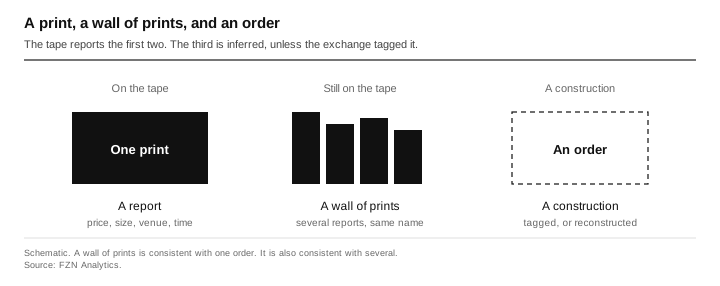
Figure 1. The tape reports prints. A wall of prints is consistent with one order. It is also consistent with several. An order is a construction: tagged at the exchange, or reconstructed from the prints.
The distinction is load-bearing because the alternative is a product that states inferences as facts. A tagged floor print is not “this was a floor trade.” A reconstructed pair of legs is not “someone opened a spread.” The first is a report. The second is a pattern. Mixing them is how a tape becomes a story.
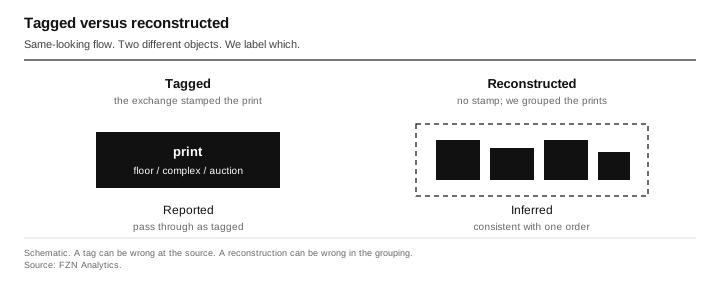
Figure 2. A tag is reported: the exchange stamped the print. A reconstruction is inferred: we grouped prints that were not stamped as one order. Both can be wrong. Only one of them is a report.
A tape product that stops at the left of Figure 3 treats thirty-three prints as thirty-three trades. They are three names, all untagged. TQQQ at the bid, SPCX at the ask, NVDA at the bid: each is one contract, one side, a handful of milliseconds, many venues. That is a reconstruction. Cleaner is not the same as certain.
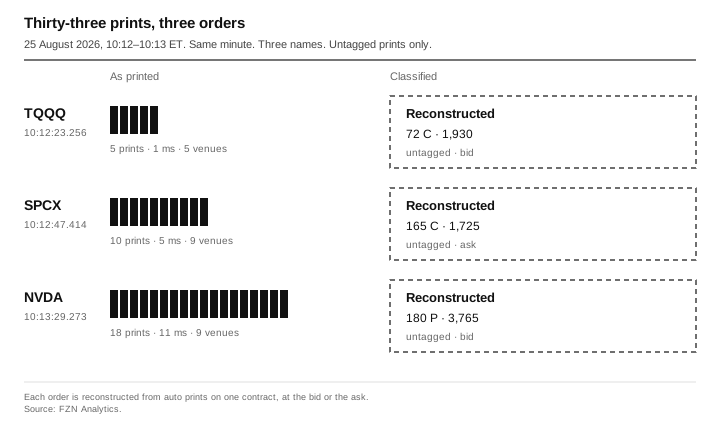
Figure 3. Same minute, 25 August 2026, 10:12–10:13 ET. Thirty-three auto prints, three names, three reconstructed sweeps. TQQQ 72C 1,930 at the bid; SPCX 165C 1,725 at the ask; NVDA 180P 3,765 at the bid. No complex tag, no midpoint, no floor package. Not a workspace screenshot.
Aggressor is a location, not a motive
Options prints do not arrive with a buy or a sell. Dmitriy Muravyev (2016), working from OPRA, is explicit: the tape does not report trade direction. Direction is inferred by applying the quote rule to the National Best Bid and Offer. A print at the ask is signed as a buy. A print at the bid is signed as a sell. If the print is at the midpoint of the NBBO, Muravyev applies the quote rule to the executing venue’s own best bid and offer.
Savickas and Wilson (2003) measured those rules against a Cboe file that did carry true direction. On classifiable option trades the quote rule signed 83 percent correctly; Lee and Ready, 80 percent; Ellis, Michaely, and O’Hara, 77 percent; the tick rule, 59 percent. Exclude complex index legs and the quote rule rises above 87 percent. On equities the ranking runs the other way. Ellis, Michaely, and O’Hara, on Nasdaq: quote 76 percent, tick 78 percent, Lee and Ready 81 percent. Lee and Ready beats the quote rule on stocks because its midpoint fallback is the tick rule, and on stocks the tick rule helps. On options the tick rule is barely above a coin flip. Lee and Ready underperforms the plain quote rule because it delegates the hard case to the rule that fails hardest. We will not tick-test a midpoint print into a buy or a sell. That is not a preference. It is the measurement.
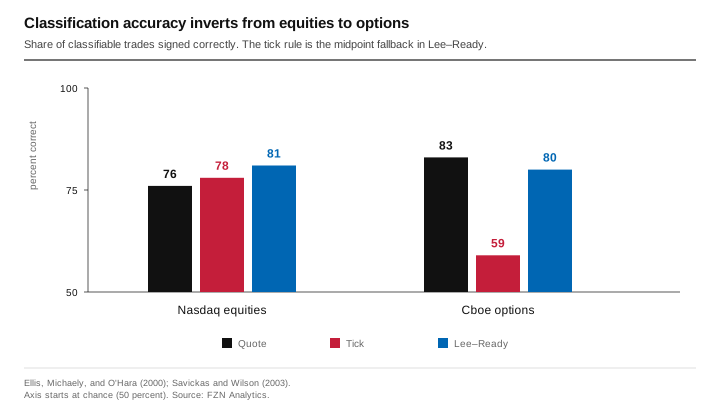
Figure 4. On stocks, Lee–Ready beats the quote rule because the tick fallback helps. On options the tick rule is 59 percent. Lee–Ready underperforms the quote rule because it delegates the hard case to the rule that fails hardest. Classifiable samples. Ellis, Michaely, and O'Hara (2000); Savickas and Wilson (2003).
That is not a rounding error you can ignore and still talk about “net premium.” Any signed flow number is only as good as the sign on each print. Classification error is first-order for the claim.
Odders-White (2000), using NYSE order records that identify the initiator, broke the same error down by where the print sat. At or outside the quotes, Lee and Ready was right 89.6 percent of the time. Inside the spread but not at the midpoint, 78.2 percent. At the midpoint, 62.6 percent. A binary buy/sell label discards the one variable that predicts its own reliability. Aggressor is a location. A print at the midpoint is not a side. We will not call mid “neutral flow,” as if unsigned were a view. Directional net premium — calls bought and puts sold, minus calls sold and puts bought — excludes a print that has no aggressor. Mid is not in that sum, and it should not be.
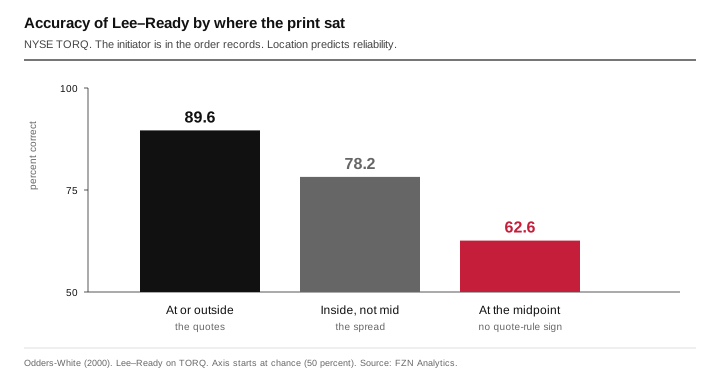
Figure 5. Odders-White (2000), TORQ. At or outside the quotes, 89.6 percent. Inside the spread but not at the midpoint, 78.2 percent. At the midpoint, 62.6 percent. A binary buy/sell discards the variable that predicts its own reliability.
The location itself can be an artifact. Fu, Li, Musto, and Pearson (2025), on SPX weekly 0DTE at Cboe, find that when a trade consumes the best bid or offer, the new quote often carries an earlier timestamp than the trade. Compared with the quote that looks like it prevailed, 38 percent of call and put trades on 1 July 2022 appear to execute inside the BBO — which those marketable prints cannot do. Their sample is one product, one venue; the share of that inversion fell from 89 percent in July 2020 to 16 percent by September 2023. The point is not that every inside print is a sequencing error. It is that “price against the NBBO” is only as good as the quote you were handed, and the tape sometimes hands you the quote that came after.
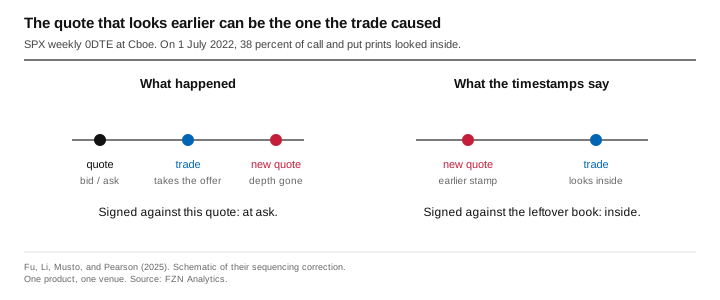
Figure 6. Fu, Li, Musto, and Pearson (2025), SPX weekly 0DTE at Cboe. When a trade consumes the offer, the new quote often timestamps earlier than the print. Signed against that quote, a marketable print looks inside. Their sample, not a desk we measured. Whether the same inversion sits in the NBBO we sign against on other names is open.
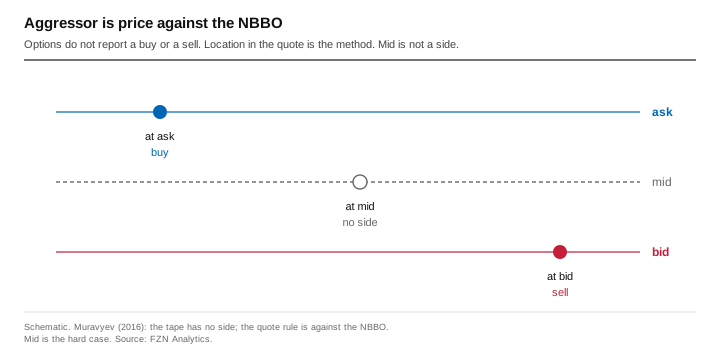
Figure 7. A print at the ask is signed as a buy. A print at the bid is signed as a sell. A print at the midpoint has no aggressor. Forcing a side onto it would make a directional number out of a print the quote rule cannot sign.
A wall of prints at the offer is still not “the buy.” It is a sequence of locations. Whether those locations are one order is a different construction.
A package is not the legs
A complex order, in the exchange’s own language, is not two prints that happen to look related.
Cboe’s U.S. Options Complex Book Process defines it: an order for two or more different options series, sent to the exchange as a single order, filled at a net price and a ratio. That is the opposite of sending two or more individual orders. The exchange may then leg the package into the simple book. Some structures can; some cannot. Either way, what the public tape often shows is the legs.
The last-sale message on OPRA is 43 bytes. There is no package identifier, no strategy identifier, no leg count. The trade-identifier field is reserved and sent as zeros. Each leg is an independent record, sometimes flagged as complex, never cross-referenced to its siblings.
Nasdaq Options Regulatory Alert 2025-23 is the same seam from the other side. Splitting the legs of a complex order in a way that distorts the risk of the package can violate just-and-equitable principles of trade. The example in that alert is exposing each leg separately rather than as one package. The point for a reader of the tape is not the disciplinary case. It is that the market already knows a package can be taken apart, and that the public record of that event is often the parts.
So some multi-leg flow is tagged. A print that carries an exchange complex-order tag is reported as tagged. Most multi-leg flow arrives as legs: same underlying, different series, often on more than one venue, often without a stamp that says they belong together. The one published reconstruction of those packages — Li, Musto, and Pearson, for the SEC — starts from prints already flagged as complex, grouped on the same exchange. Untagged legs, and legs that printed on two venues, are outside that method by construction. Reconstructing untagged legs as a structure is an inference. It is consistent with a complex order when the sizes, the ratio, and the timing line up. It is not “we know it was a spread.”
Even with the flag, and even with the legs grouped, the structure is not always recoverable. Li, Musto, and Pearson: a straddle and a combination are the same two contracts; they cannot tell them apart by signing the legs, because the package traded at a single net price.
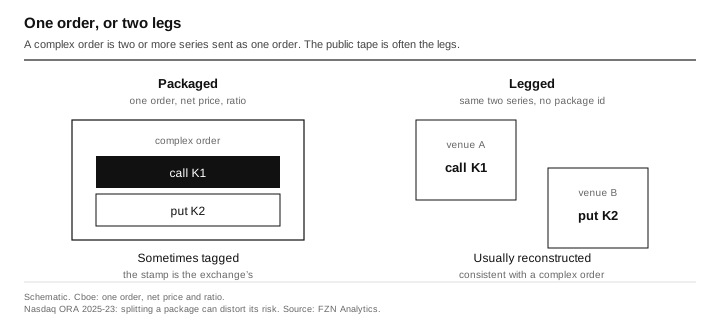
Figure 8. Left: two series sent as one order, at a net price and a ratio. Right: the same two series printing as legs on two venues. The public tape is often the picture on the right. OPRA does not carry a package id.
Anand and Chakravarty (2007) documented the same shape one layer down, in single-leg flow. Options volume fragments: small trades in quieter contracts, medium trades in busier ones, and almost 60 percent of price discovery on the exchange that already has the largest share. A wall of prints, even in one contract, is not one order unless you have a reason to say so. Across contracts, across venues, the reason has to be better still.
Confidence is not certainty
A tag is a report. A reconstruction is an inference. An inference can be strong. Similar size, the same underlying, a recognizable structure, prints that arrive together: that is high confidence, and the reason is the pattern, not a feeling about the name. It is still an inference.
The product failure is binary language. “Confirmed.” “We know.” “An institution opened.” Those sentences have no way to be a little wrong. They are right until the first time they are not, at which point the method has nothing to say for itself.
We attach a confidence to a reconstruction because that is what the object is. We label tagged versus reconstructed because those are different objects. We will not present a reconstruction as a fact with a score on it that makes it a fact.
The ordinary tape, and the messy one
Most prints are ordinary. One contract. One venue. Price at the bid or the ask. Nothing to reconstruct. Classification on those prints is the quote rule doing what it was built to do, and the tag, if there is one, passing through. There is not much in that tape to get wrong, and not much to derive. The machine is printing what it is supposed to print.
Classification matters when the tape is messy. Cross-venue. Multi-leg. A print inside the quotes. A wall that might be one order or several. A package that arrived as legs. That is also when reconstruction is hardest. Odders-White’s failures sit at the midpoint. Savickas and Wilson’s tick rule sits at 59 percent. Fu, Li, Musto, and Pearson’s inside prints are partly a timestamp. Anand and Chakravarty’s fragmentation is why a wall is not an order. The day you would have wanted a perfect classification is the day the methods have the least to give.
Ordinary sessions train the messy-tape mistake. Most days the prints are clean, the signs are at the touch, and a cluster that looks like a structure is a structure. Those days are numerous, and they look like a method. The day the tape is a wall of legs across venues, or a slug at the midpoint, is the day a screenshot of “the order” is least about what traded.
When the reconstruction works anyway
A reconstructed structure is often accurate enough that the next hour looks like the structure. Spot goes the way a call spread would want; the reconstruction gets the credit. Sometimes the legs really were one order, still sitting, still the package you inferred. That happens. It is not rare enough to be dismissable, and not common enough to be a law.
It is also often not accurate enough, and the market does what you expected anyway. A dynamic tape has many reasons to move the way a spread implied: the name was going there; the session was quiet; a different book was long the same strikes; the move died for reasons that have nothing to do with these legs. When price does the thing, the structure is treated as the cause. When it does not, there is always a story: it was a hedge, it was a roll, it was a different expiry, wait for the next print.
Hits are visible. Misses are explained. A method that is allowed to be right for the wrong reason does not get abandoned. That is not only a side effect of a market that has more than one cause. It is how a convenience grouping becomes, in public, a known order.
The test is not whether the structure “worked.” The test is whether you could have known, before the next print, that these legs were one order, on one side, as that structure. The tag can tell you, with error, that the exchange stamped them as a package. Reconstruction can tell you they are consistent with a package. Neither is proof that the reconstruction caused the move, and a screenshot after the move cannot tell you either.
What we still show
We still show the tape. A print is a print: price, size, venue, time, the contract. That is a report.
Exchange tags we show as tagged. Floor, auction, complex-order: the stamp is the exchange’s. ISO is a single-leg tag — an intermarket sweep, not a spread. A single-leg auction tag is not a spread either. We will not upgrade a tag into “this was.”
Aggressor we show as a location against the NBBO. At the ask, at the bid, inside, at the midpoint. Mid is labeled as mid. It is not a side, and it is not in directional net.
Prints that look like one order we will group, and we will label the grouping as reconstructed. Legs that look like a structure we will group the same way: consistent with a complex order, not “the order as it was worked.” Tagged packages pass through as tagged. Untagged legs that we join are a reconstruction.
Today’s signed flow we will show as today’s signed flow: who initiated, in this session, in this contract, where the quote rule can sign it. That is not a book, and it is not a package carried forward from a wall of prints.
What a serious trader can use
Use a tag as a tag. Someone or something at the exchange stamped the print. That is worth knowing. It is not a photograph of the order.
Use a reconstruction as a reconstruction. Similar size, the same underlying, a recognizable structure, prints that arrived together: that is a reason. It is not a known spread, and it is not a known side on a midpoint print.
Do not read a wall of prints as one order on an ordinary day without saying why. Do not read two legs as a package because the next hour went the right way. The dangerous step is not grouping prints. It is reading an order, a side, and a structure out of a tape that reported none of those, and then keeping the method because the clean tape confirmed it often enough.
Sources
Muravyev, Dmitriy. “Order Flow and Expected Option Returns.” Journal of Finance 71, no. 2 (2016): 673–708, and the Internet Appendix, section A.4. OPRA does not report option trade direction; the quote rule is applied to the NBBO, and at the midpoint to the executing venue’s BBO.
Savickas, Robert, and Arthur J. Wilson. “On Inferring the Direction of Option Trades.” Journal of Financial and Quantitative Analysis 38, no. 4 (2003): 881–902. Proprietary Cboe file with true direction. Quote rule 83 percent, Lee and Ready 80 percent, Ellis–Michaely–O’Hara 77 percent, tick rule 59 percent, on classifiable trades. Quote rises above 87 percent excluding complex index legs.
Ellis, Katrina, Roni Michaely, and Maureen O’Hara. “The Accuracy of Trade Classification Rules: Evidence from Nasdaq.” Journal of Financial and Quantitative Analysis 35, no. 4 (2000): 529–551. Abstract: quote 76 percent, tick 78 percent, Lee and Ready 81 percent; limited success inside the quotes. The ranking inverts on options.
Odders-White, Elizabeth R. “On the Occurrence and Consequences of Inaccurate Trade Classification.” Journal of Financial Markets 3, no. 3 (2000): 259–286. TORQ order records. Lee and Ready: 89.6 percent at or outside the quotes, 78.2 percent inside the spread but not at the midpoint, 62.6 percent at the midpoint.
Fu, Lei, Su Li, David K. Musto, and Neil D. Pearson. “Hope at a Reasonable Price: Customer Use of Limit Orders in the 0DTE Market.” SEC DERA working paper, 16 March 2025. SPX weekly 0DTE at Cboe: the quote caused by a trade often timestamps earlier than the trade; 38 percent of call and put prints on 1 July 2022 appear to execute inside the prevailing BBO. Out-of-sequence share 89.3 percent (July 2020) to 16.3 percent (September 2023).
Li, Su, David K. Musto, and Neil D. Pearson. “Simple Roles for Complex Options.” SEC DERA working paper, 4 March 2024. Reconstruction starts from flagged complex prints, same exchange. Cannot distinguish a straddle from a combination by signing the legs: the package is a net price. After 4 November 2019, OPRA codes name protocol, not strategy.
Anand, Amber, and Sugato Chakravarty. “Stealth Trading in Options Markets.” Journal of Financial and Quantitative Analysis 42, no. 1 (2007): 167–187. Abstract: options flow fragments — small trades in quieter contracts, medium in busier ones — and almost 60 percent of price discovery occurs on the exchange with the largest share.
Cboe. Titanium U.S. Options Complex Book Process (2026). A complex order is an order for two or more different options series sent to the exchange as a single order, filled at a net price and a ratio, unlike sending two or more individual orders. The exchange may then leg the package into the simple book.
Options Price Reporting Authority. Binary Data Recipient Interface Specification, version 6.4a (1 July 2026). Last-sale message is 43 bytes. No package, strategy, or leg-count field. Trade identifier reserved, sent as zeros.
Nasdaq. Options Regulatory Alert 2025-23, 28 May 2025. “Breaking Up Complex Options Orders.” Splitting the legs of a complex order in a way that distorts the risk of the package may be inconsistent with just and equitable principles of trade. The public tape of a split package is the legs.